

*EDIT*
This article was originally published when we were using the name Aftermath Strength & Conditioning. We’ve been a CrossFit affiliate since opening, and have recently transitioned to using CrossFit Somonauk across everything we do.
Why Running Form Matters More Than You Think
Many people think running is simple.
Put one foot in front of the other, move faster than walking, and keep going.
While that may technically be true, the way you run has a huge impact on how efficient, comfortable, and sustainable running actually feels.
For many runners—especially beginners—poor running mechanics can lead to unnecessary fatigue, slower progress, and even injuries.
That’s where running form comes in.
One of the most widely taught systems for improving running technique is the POSE Method, which is also the foundation of the running instruction taught in the CrossFit Running Certification. Instead of focusing on pushing harder or running longer, the POSE Method emphasizes efficient movement patterns that allow gravity and momentum to do more of the work.
Understanding a few key principles can dramatically change how running feels.
Why Running Form Is So Important
Running places repeated stress on the body.
Each step can create impact forces several times your body weight. If those forces are handled efficiently, your body can tolerate them well. If they’re handled poorly, stress begins to accumulate in joints and tissues.
Common problems many runners experience include:
- Knee pain
- Shin splints
- Hip tightness
- Lower back discomfort
In many cases, these issues aren’t caused by running itself. They’re caused by inefficient mechanics.
Improving running form helps distribute forces more effectively throughout the body. It also reduces wasted energy, which means you can run longer or faster with less effort.
The Core Idea Behind the POSE Method
The POSE Method teaches that running is not about pushing the body forward.
Instead, running is about falling forward under control.
Gravity creates forward momentum, and the runner simply supports and redirects that motion efficiently.
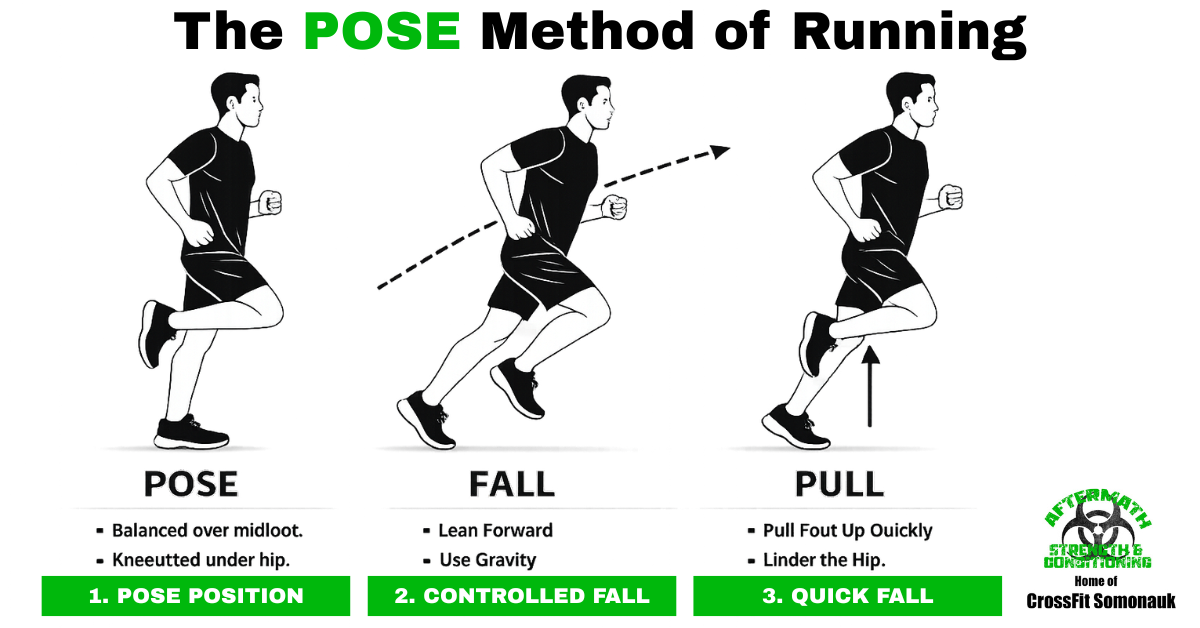
The method breaks running down into three key components:
- Pose
- Fall
- Pull
These simple ideas form the foundation of efficient running.
1. The Pose Position
The “pose” is the ideal body position during running.
In this position:
- Your body is upright but slightly leaning forward from the ankles
- Your weight is balanced over the midfoot
- Your support leg is underneath your center of mass
- The opposite foot is pulled up under the hip
This alignment keeps your body stacked and balanced, which allows you to move efficiently without overreaching or braking.
A common mistake many runners make is landing with the foot far in front of the body. This creates a braking force that slows you down and increases impact stress.
The pose position avoids that problem by keeping your support directly under your body.
2. The Fall
Once you’re in the correct position, forward movement happens through a controlled fall.
Instead of pushing off the ground, the runner leans slightly forward from the ankles.
Gravity begins to pull the body forward, and the runner simply allows that motion to happen while maintaining balance.
This concept may sound strange at first, but it’s actually how efficient running works.
Trying to push yourself forward with your legs often creates excessive muscular effort and fatigue. Allowing gravity to initiate forward motion reduces the energy required for each step.
3. The Pull
The final component is the pull.
After your foot touches the ground under your body, the goal is to quickly pull the foot off the ground and return it underneath your hips.
This movement happens primarily with the hamstrings, not by pushing off the ground.
A quick pull helps reduce the amount of time your foot stays in contact with the ground, which minimizes impact forces and keeps your stride quick and efficient.
Instead of long, reaching strides, POSE runners focus on shorter, faster steps with a higher cadence.
Common Running Form Mistakes
Many runners unintentionally develop habits that make running harder than it needs to be.
Some of the most common issues include:
Overstriding
Landing with the foot far in front of the body creates braking forces and increases stress on the knees.
Heel Striking Far Ahead of the Body
While heel contact itself isn’t always the problem, landing far in front of your center of mass often leads to inefficient movement patterns.
Pushing Off Too Hard
Trying to power forward with the calves and quads increases fatigue and reduces efficiency.
Low Cadence
Long, slow strides typically increase impact forces and reduce running economy.
The POSE Method helps correct these issues by encouraging better body positioning and faster, lighter steps.
Why This Matters for Everyday Athletes
Running form isn’t just important for competitive runners.
It matters for anyone who wants to run comfortably, whether that’s:
- Training for a 5K
- Improving conditioning
- Preparing for workouts like Murph
- Building overall fitness
Efficient mechanics make running feel smoother and more sustainable.
Instead of fighting the ground with every step, your body begins to move rhythmically and naturally.
Over time, this can reduce injury risk and make running a much more enjoyable part of training.
The Bottom Line
Running might seem simple, but how you run makes a big difference.
The POSE Method teaches runners to move more efficiently by focusing on body position, gravity, and quick foot movement.
Instead of forcing speed through effort alone, good running mechanics allow your body to work with natural forces instead of against them.
For everyday athletes, improving running form can mean less fatigue, fewer injuries, and a more enjoyable experience every time you lace up your shoes.
Sometimes the biggest improvements don’t come from running harder—they come from running smarter.

BOOK YOUR FREE NO SWEAT INTRO TODAY
Take the first step toward a healthier, stronger you—no pressure, no workout required. Just a simple conversation about your goals and how we can help.
Comments are closed